






Artificial Intelligence (AI) is no longer a futuristic concept, but a present-day reality that small businesses are increasingly turning to for growth and development. As we approach 2026, AI continues to reshape how businesses operate, regardless of their size. For small businesses in particular, AI offers a treasure trove of tools and capabilities that can accelerate growth, streamline operations, enhance customer experiences, and provide a competitive edge in an ever-evolving market.
In this blog, we will explore how AI can help small businesses grow faster in 2026, touching upon key areas such as marketing, customer service, data analysis, operations, and decision-making.
Why Work with an Experienced AI Technology Partner?
Implementing AI is not just about installing tools. It requires:
- Strategic planning
- Secure architecture
- Clean data integration
- Ongoing optimization
At Compilex Technologies, we work with small and growing businesses to design AI solutions that solve real operational problems. Our focus is not just automation – but measurable business growth.
From AI automation systems to intelligent analytics integration, our team ensures that every solution aligns with long-term business goals.
Learn more about our AI development services.

1. AI-Powered Marketing for Enhanced Customer Reach
One of the most significant ways AI is empowering small businesses is through advanced marketing strategies. Small business owners often have limited marketing budgets, but AI enables them to maximize the impact of their campaigns without breaking the bank.
Personalized Marketing Campaigns
AI can analyze vast amounts of customer data to identify patterns, preferences, and behaviors. This information allows small businesses to create highly personalized marketing campaigns. AI-powered tools, such as email marketing automation platforms, can send tailored messages to customers based on their previous interactions, boosting engagement and conversion rates.
For example, if a customer has recently browsed products on your website but hasn’t made a purchase, AI can send a follow-up email with personalized recommendations, discounts, or reminders, leading to higher chances of conversion.
Social Media Automation
AI tools also enable businesses to automate and optimize their social media marketing efforts. AI-driven platforms can schedule posts, recommend optimal times to publish content, and even suggest hashtags that are likely to increase visibility. Small businesses can save time and effort by allowing AI to manage social media tasks, allowing business owners to focus on other strategic areas.
2. Improved Customer Service with AI Chatbots
In 2026, offering exceptional customer service is no longer optional – it is a critical factor for success. AI-powered chatbots are revolutionizing customer service by providing real-time, round-the-clock support for customers. These chatbots can handle a wide range of inquiries, from answering frequently asked questions to processing orders, providing shipping updates, and resolving common issues.
AI chatbots ensure that small businesses can engage with customers 24/7 without the need for a large customer support team. They can handle multiple inquiries simultaneously, providing quick and accurate responses that enhance customer satisfaction and loyalty. This not only helps businesses reduce overhead costs but also frees up human agents to focus on more complex issues.
3. Data-Driven Decision Making
Small businesses often struggle with making data-driven decisions due to limited access to sophisticated analytics tools. AI changes the game by enabling businesses to gather, process, and analyze vast amounts of data quickly and accurately.
Predictive Analytics
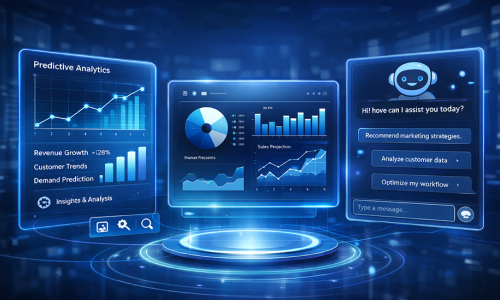
Predictive analytics, powered by AI, helps businesses make informed decisions by forecasting future trends and customer behaviors. For instance, small businesses can use AI to predict demand for specific products, optimize inventory levels, or adjust pricing strategies based on market conditions. This ensures that businesses are proactive rather than reactive, positioning them for sustained growth.
Enhanced Market Research
AI can also help small businesses gain insights into their target audience and market trends. By analyzing competitors’ strategies, consumer preferences, and industry patterns, AI can uncover valuable insights that guide product development, marketing strategies, and customer acquisition tactics.
4. AI for Optimizing Operations
For small businesses, operational efficiency is key to long-term success. AI can automate repetitive tasks, improve workflows, and reduce human errors, allowing business owners and employees to focus on more strategic, value-adding activities.
AI-Driven Automation
Many time-consuming administrative tasks such as data entry, invoicing, and payroll processing can be automated with AI-powered tools. For example, AI can help businesses automate the process of managing customer orders, generating invoices, and updating inventory records. This reduces the likelihood of human errors and ensures that critical tasks are completed quickly and accurately.
Supply Chain Optimization
AI also helps small businesses optimize their supply chain management. With AI, businesses can predict supply and demand fluctuations, identify potential bottlenecks, and select the best suppliers or shipping methods. These AI tools enable small businesses to reduce operational costs, improve delivery times, and enhance the overall customer experience.
5. Cost Reduction with AI
Small businesses often face budget constraints and must find ways to minimize costs while maintaining high-quality service. AI offers several ways to reduce operational expenses without sacrificing growth potential.
Automating Customer Interactions
AI-powered chatbots and virtual assistants can take over customer service tasks that would typically require human agents, such as answering questions, scheduling appointments, and processing returns. By doing so, businesses can reduce the need for a large customer service team, cutting labor costs.
Optimizing Ad Spend
AI can also optimize digital advertising campaigns, ensuring that businesses get the most out of their marketing budget. AI platforms use machine learning algorithms to analyze past ad performance, identify the most effective keywords, and adjust bids in real-time. This reduces wasted ad spend, increases return on investment (ROI), and helps small businesses reach their target audience more effectively.
6. Improved Security and Fraud Prevention
With the rise of online transactions and digital interactions, small businesses are more vulnerable to cyber threats than ever before. AI-powered security systems can help protect sensitive data and prevent fraud.
AI-Based Fraud Detection
AI can detect unusual patterns and behaviors within transaction data, helping businesses spot and prevent fraudulent activity. Whether it’s detecting credit card fraud, identifying fake reviews, or preventing unauthorized access to accounts, AI can play a pivotal role in safeguarding both businesses and their customers.
Cybersecurity Protection
AI tools equipped with machine learning capabilities can continually monitor networks for vulnerabilities, identify threats, and respond to security breaches in real-time. By leveraging AI for cybersecurity, small businesses can enhance their data protection without relying on costly human resources.
Why Choose Compilex Technologies for AI Implementation?
Choosing the right technology partner determines the success of your AI investment. At Compilex Technologies, we focus on:
- Business-first AI strategy
- Secure and scalable architecture
- Transparent implementation process
- Ongoing technical support
- Data-driven optimization
Conclusion
As we move towards 2026, small businesses have the opportunity to embrace AI to accelerate their growth, enhance efficiency, and deliver exceptional customer experiences. Whether it’s through AI-powered marketing, improved customer service, data-driven decision-making, or optimized operations, AI has the potential to transform the way small businesses compete in the marketplace.
If you are planning to adopt AI in 2026, partnering with the right technology team makes the difference. Contact Compilex Technologies today to discuss your AI growth strategy.