





Businesses today need more than standard software to stay competitive. Every organisation has unique workflows, operational challenges, and growth objectives that require tailored digital solutions. This is where custom application development services play a vital role. Unlike off-the-shelf software, custom applications are designed specifically to meet a company’s unique requirements, providing better scalability, security, and long-term flexibility.
In this guide, we’ll explore the top technologies used in custom application development services, their benefits, and how businesses can select the right technology stack for long-term success.
What Are Custom Application Development Services?
Custom application development services involve designing, developing, testing, and maintaining software applications that are built specifically for an organisation’s business needs. Rather than adapting business processes to fit pre-built software, custom applications are tailored to improve productivity, automate workflows, and solve unique operational challenges.
These services often include:
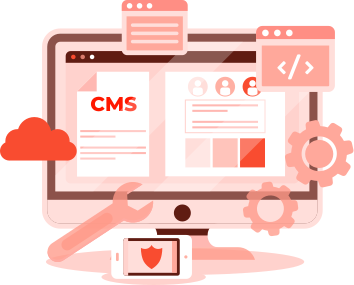
- Custom web application development
- Enterprise software development
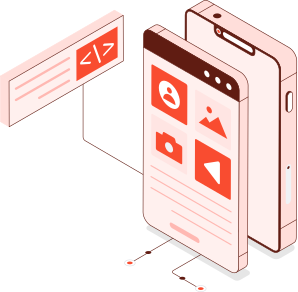
- Mobile application development
- SaaS platform development
- API integration
- Cloud application development
- Software maintenance and support
Businesses across healthcare, finance, retail, logistics, education, and manufacturing rely on custom applications to improve efficiency and gain a competitive advantage.
Why Choosing the Right Technology Stack Matters
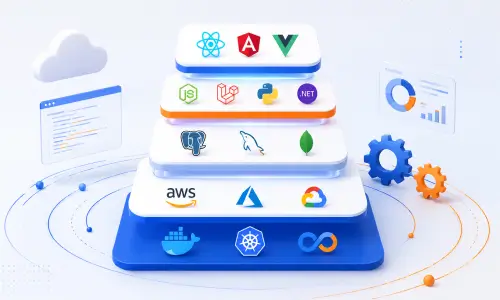
The technology stack forms the foundation of every custom application. Selecting the wrong technologies can result in poor performance, security vulnerabilities, expensive maintenance, and limited scalability.
A well-planned technology stack offers several advantages:
- Faster application performance
- Better user experience
- Enhanced security
- Easier scalability as the business grows
- Seamless integration with third-party systems
- Reduced maintenance costs
- Faster development cycles
Professional software development companies carefully evaluate business objectives before recommending technologies rather than simply choosing the latest trends.
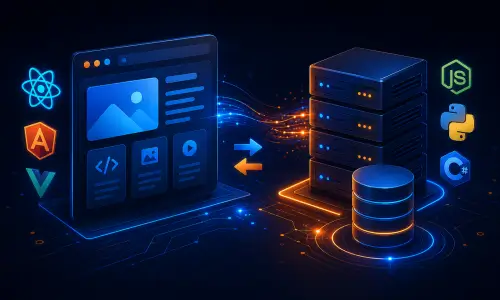
Frontend Technologies for Modern Applications
The frontend is everything users interact with. Modern frontend technologies focus on speed, responsiveness, and engaging user experiences.
React.js
React.js is one of the most popular frontend libraries for building modern web applications. Developed by Meta, it helps developers create fast, interactive, and scalable user interfaces. Its reusable components speed up development and make future updates easier. React is widely used for enterprise dashboards, SaaS platforms, customer portals, e-commerce websites, and real-time applications.
Angular
Angular is a powerful frontend framework developed by Google. It is designed for building large-scale and enterprise-grade applications with complex features. Angular offers built-in tools for security, testing, and performance, making it a reliable choice for long-term projects such as enterprise management systems, banking applications, healthcare platforms, and other business software.
Vue.js
Vue.js is a lightweight and flexible frontend framework known for its simplicity and ease of use. It enables developers to build responsive and high-performing applications quickly. Vue.js is an excellent choice for startups and businesses that need faster development and is commonly used for business dashboards, customer portals, progressive web applications, and small to medium-sized business solutions.
Backend Technologies That Power Business Applications
While the frontend focuses on user experience, the backend handles business logic, databases, authentication, and application performance.
Node.js
Node.js is a popular backend technology for building fast and scalable applications. Its non-blocking architecture allows it to handle multiple requests at the same time, making it ideal for real-time applications, chat platforms, SaaS products, APIs, and cloud-based solutions. Businesses choose Node.js for its speed, efficiency, and ability to support high-traffic applications.
Laravel (PHP)
Laravel is a modern PHP framework known for its clean syntax and rapid development process. It offers built-in security, easy API integration, and excellent scalability, making it a preferred choice for custom web applications. Laravel is widely used to develop business portals, CRM systems, ERP software, and enterprise web solutions.
Python
Python is one of the most versatile programming languages used in modern software development. It is especially popular for Artificial Intelligence (AI), Machine Learning (ML), automation, and data-driven applications. Its extensive libraries and simple syntax help developers build powerful solutions faster while supporting innovation across industries like healthcare, finance, and analytics.
.NET
Microsoft’s .NET framework is a trusted choice for developing secure and high-performance enterprise applications. It integrates seamlessly with the Microsoft ecosystem and provides excellent security, scalability, and reliability. .NET is commonly used for government systems, ERP platforms, financial applications, and other large-scale business solutions where stability and performance are critical.
Mobile Application Technologies
With mobile users continuing to grow, businesses increasingly invest in mobile applications alongside web platforms.
Flutter
Flutter is Google’s open-source framework for building cross-platform mobile applications using a single codebase. It delivers fast performance, a consistent user experience, and native-like functionality across Android and iOS. Businesses choose Flutter to launch applications quickly while keeping development costs under control.
React Native
React Native is a popular framework developed by Meta for creating cross-platform mobile apps. It allows developers to reuse code across platforms without compromising performance. It is widely used for business applications, e-commerce platforms, customer engagement apps, and on-demand service solutions. Its flexibility and faster development cycle make it a preferred choice for many businesses.
Database Technologies
Every application requires reliable data storage and management.
PostgreSQL
PostgreSQL is a powerful open-source relational database known for its reliability, scalability, and advanced features. It is widely used for enterprise applications that require complex data processing, high performance, and strong data integrity.
MySQL
MySQL is one of the world’s most popular relational databases and is trusted for its speed, stability, and ease of use. It is commonly used for business websites, customer relationship management (CRM) systems, e-commerce platforms, and SaaS applications, making it an excellent choice for a wide range of business solutions.
MongoDB
MongoDB is a flexible NoSQL database designed to handle large volumes of unstructured and rapidly changing data. It is ideal for content management systems, social media platforms, IoT applications, and big data solutions where flexibility and scalability are essential.
Cloud Technologies
Popular cloud platforms include:
Modern custom application development services increasingly rely on cloud infrastructure for flexibility, reliability, and scalability.
- Amazon Web Services (AWS)
- Microsoft Azure
- Google Cloud Platform (GCP)
Cloud technologies offer numerous benefits:
- On-demand scalability
- Reduced infrastructure costs
- High availability
- Disaster recovery
- Enhanced security
- Global deployment
Cloud-native development also enables businesses to launch applications faster while supporting future growth.
DevOps and Deployment Technologies
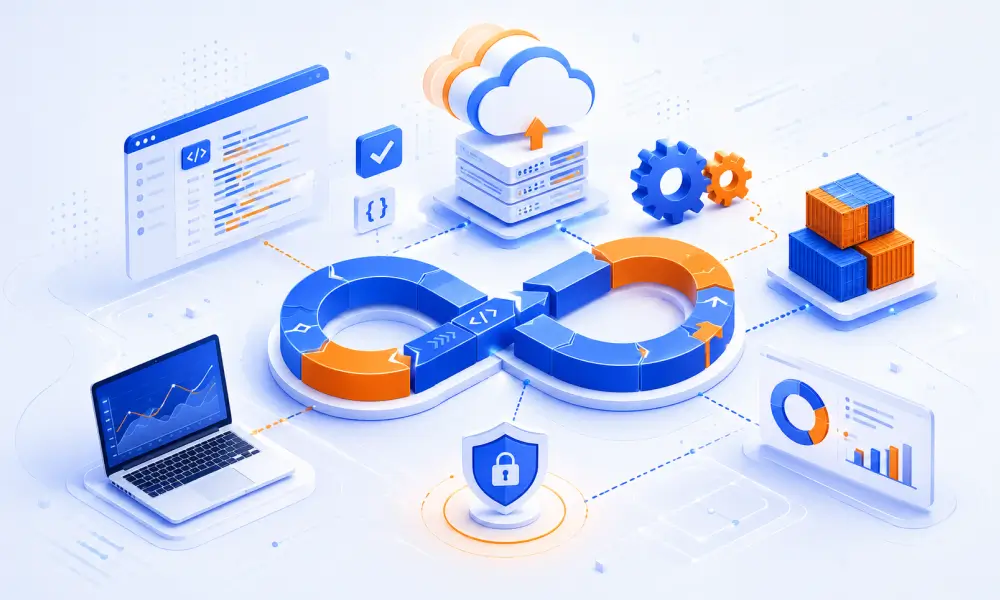
Efficient software delivery requires more than writing code. DevOps practices help development and operations teams collaborate effectively.
Common DevOps technologies include:
- Docker
- Kubernetes
- GitHub Actions
- Jenkins
- CI/CD pipelines
These tools enable:
- Faster software releases
- Automated testing
- Reliable deployments
- Reduced downtime
- Continuous improvement
Businesses adopting DevOps can respond more quickly to changing customer demands while maintaining software quality.
AI and Emerging Technologies
Modern applications increasingly integrate advanced technologies to improve automation and user experiences.
Some of the fastest-growing technologies include:
- Artificial Intelligence (AI)
- Machine Learning (ML)
- Generative AI
- Blockchain
- Internet of Things (IoT)
As digital transformation accelerates, integrating AI into custom applications is becoming a strategic advantage for businesses across industries.
How to Choose the Right Technology Stack
There is no single technology stack that works for every project. The right choice depends on your business goals and project requirements. Consider factors like project complexity, expected users, budget, timeline, security, and future growth. You should also think about third-party integrations and long-term maintenance. Choosing the right technologies from the start helps improve performance, reduce costs, and support scalability. Working with an experienced software development partner ensures your technology stack is aligned with your business objectives and built for long-term success.
Why Partner with Compilex Technologies?
At Compilex Technologies, we build scalable, secure, and future-ready applications tailored to your business objectives. Our development teams carefully evaluate every project before selecting the most suitable technologies, ensuring optimal performance and long-term maintainability.
By combining modern technologies with agile development practices, we help businesses accelerate digital transformation while delivering solutions that grow alongside their operations.
Conclusion
The right technology stack is the foundation of a successful application. Front-end frameworks like React and Angular, backend technologies such as Node.js, Laravel, Python, and .NET, along with cloud platforms, databases, DevOps, and AI, each play an important role in building modern software.
Choosing the right technologies isn’t about following trends. It’s about selecting tools that match your business goals, budget, and future growth plans. A well-planned technology stack improves performance, security, scalability, and long-term reliability.
If you’re looking for reliable custom application development services, partnering with an experienced team makes all the difference. At Compilex Technologies, we build tailored software solutions using the right technologies to help businesses innovate, grow, and stay ahead in today’s digital landscape.